Quick answer
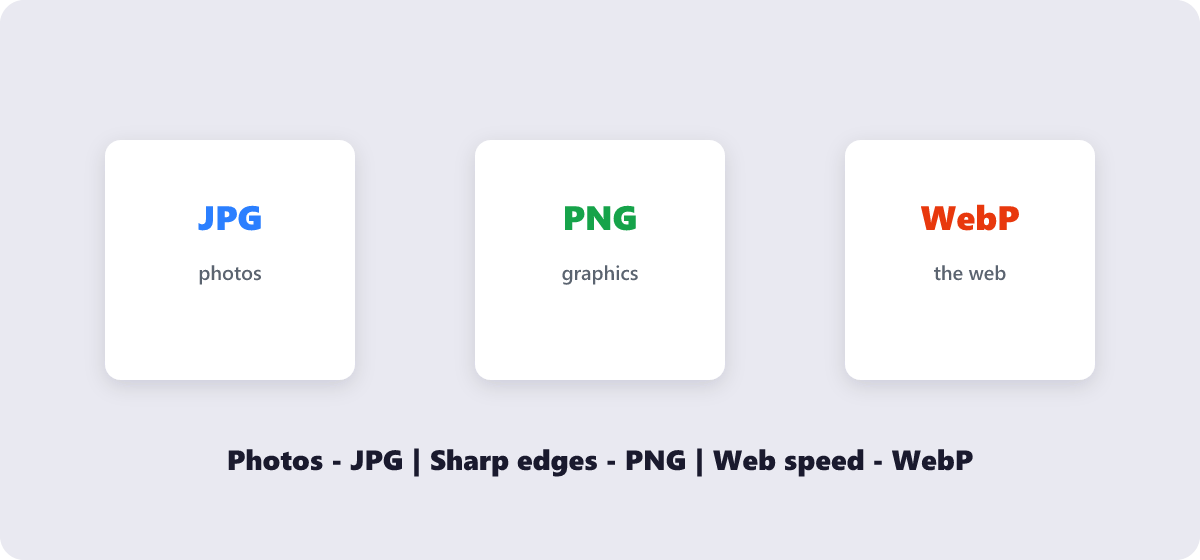
Photos → JPG. Graphics, screenshots and transparency → PNG. Web images where size matters → WebP. Wrong format costs you quality or loading speed (sometimes both). Convert between any of them free with the Convert Image tool.
JPG, PNG and WebP all store images — so why do three formats exist, and why does picking the wrong one make your website slower or your screenshot blurry? The answer is that each format compresses pictures using a completely different philosophy. Once you understand the one-line version of each philosophy, format choice stops being a guess.
What’s covered:
- JPG: the photo format
- PNG: the pixel-perfect format
- WebP: the modern web format
- The side-by-side comparison
- Three questions that decide your format
- Format questions
JPG: the photo format
JPG compression is lossy and built for photographs: it throws away detail your eye is least likely to miss, and photographs — smooth gradients, natural textures — are exactly the kind of image where that trade is invisible. A 12 MP camera photo saved as JPG might weigh 3 MB where the same picture as PNG would weigh 15 MB, with no visible difference.
The costs: JPG has no transparency (transparent areas flatten to a solid color on conversion), and repeated saving compounds artifacts — those blurry blocks around sharp edges. Text, logos, screenshots and diagrams are where JPG looks worst: their hard edges and flat colors make compression artifacts obvious.
PNG: the pixel-perfect format
PNG compression is lossless and built for precision: every pixel survives exactly as it was, forever, through unlimited re-saves. It also supports full transparency — the alpha channel that lets a logo sit on any background. That combination makes PNG the format for screenshots, logos, icons, charts and anything with text or hard edges.
The cost is weight: for photographs, PNG files run several times larger than JPG for no visible benefit. Lossless storage of a noisy, gradient-rich photo is expensive and pointless — the photo does not need pixel-perfection to look right.
WebP: the modern web format
WebP is Google’s 2010 answer to “why can’t we have JPG’s size and PNG’s transparency at once?” — and by the numbers it delivers: Google’s own figures put WebP images 25–34% smaller than comparable JPEGs and lossless WebP about 26% smaller than PNG, with alpha support in both modes. Safari held out until 2020, but current browsers representing roughly 96% of the market render it, and it was standardized as RFC 9649 in late 2024.
The remaining friction is software outside browsers: older image editors, some CMS pipelines and a long tail of desktop tools still stumble on WebP — which is exactly why format conversion tools exist.
The side-by-side comparison
| Property | JPG | PNG | WebP |
|---|---|---|---|
| Compression | Lossy | Lossless | Both |
| Transparency | No | Yes | Yes |
| Photos | Excellent, small | Large | Excellent, smaller |
| Text & sharp edges | Artifacts appear | Pixel-perfect | Very good |
| Compatibility | Universal | Universal | ~96% of browsers; some desktop tools lag |
Three questions that decide your format
- Does the image need transparent areas? Yes → PNG (or WebP). No → continue.
- Is it a photograph or a graphic with flat colors and text? Photo → JPG (or WebP). Graphic/text/screenshot → PNG.
- Is it going on a website where loading speed matters? WebP if your tools support it; JPG/PNG otherwise.
And the conversion trap worth knowing: converting JPG → PNG gains nothing. The quality JPG threw away is already gone; PNG just stores the leftovers losslessly at four times the size. Convert toward your goal, and when a PNG must become a JPG (an upload form, an email), expect transparency to flatten to a solid background — the PNG to JPG and JPG to PNG converters handle both directions.
Format questions
Which image format is smallest for photos?
WebP, usually — Google’s figures put it 25–34% below comparable JPEGs at the same quality. JPG is the close second and the safest compatibility choice.
Why does my PNG look fine but weigh so much?
Because lossless storage keeps every pixel exactly. For photos that is enormous overhead with no visible gain — convert the photo to JPG or WebP and it will look identical at a fraction of the weight.
Can JPG have a transparent background?
No — the format has no alpha channel. Transparent areas flatten to a solid color when a PNG converts to JPG. Keep transparency-critical work in PNG or WebP.
What format should website images use?
WebP where your stack supports it — smaller files mean faster pages, and browser support now covers nearly all traffic. JPG for photos and PNG for graphics remain the dependable fallbacks.
Why do my JPGs get worse every time I edit and save them?
JPG compression is lossy on every save — each pass discards more detail. Work in a lossless format (PNG) while editing, and export to JPG only as the final step.
Is WebP going to replace JPG and PNG?
On the web, largely — its size advantage and near-universal browser support have made it the default for performance-conscious sites. Outside browsers, JPG and PNG compatibility keeps them alive for years to come.
Last updated: September 19, 2026. The Convert Image tool here handles JPG, PNG, WebP, GIF and BMP both ways — free, in your browser.
